By-product recovery
Skins, stones and press residue are separated at source and routed to recovery rather than to a disposal contractor.
 +254 713 791 111
Home Sustainability
Milele Agritech generates socio-economic and environmental impact beyond avocado oil and cosmetics by supporting local industrialisation, employment, farmer market access, women's participation, and circular economy development. Its model also has the potential to reduce environmental and climate impacts through local processing, renewable energy use, and the upcycling of organic by-products into productive secondary uses.

Why it matters
Fruit goes in one end, product comes out the other, and everything that is not product becomes a disposal cost. Skins, stones and press residue are hauled away and paid for twice — once as fruit and again as waste.
A closed-loop model treats those streams as inputs to something else. That is what "total environmental circularity" means in practice: designing the plant so that the material leaving the extraction stage has somewhere useful to go before it is ever classified as waste.
The same logic applies to people. A processing plant that draws its fruit, its workforce and its distributors from the communities around it keeps the value circulating locally instead of exporting it along with the product.
Environmental circularity
Each stream from the extraction line has a defined destination before the season starts.
Skins, stones and press residue are separated at source and routed to recovery rather than to a disposal contractor.
Organic residue returns to farming communities as soil input, closing the loop where the fruit originally came from.
Formulations are built on natural inputs, which keeps the finished cleaning and cosmetic products easier on the systems they end up in.
The 5 L and 20 L formats exist so institutions refill pump bottles instead of buying and discarding new packaging every month.
Pressing and manufacturing in Kenya removes the freight, the double handling and the emissions of shipping raw fruit out and finished goods back.
Oil that does not meet culinary grade still has a home in cosmetic and cleaning formulations. Two business units means fewer rejected batches.
Inclusion
Not a single programme bolted onto the side of the business, but a commitment applied at every stage where money changes hands.
Women farmers are contracted and paid directly, in their own name, rather than through an intermediary. Direct payment is the difference between contributing to a household income and controlling one.
Industrial manufacturing roles processing, quality, packing and line supervision are deliberately opened to women, including the technical and supervisory positions that carry progression.
Women-led retailers, salons, pharmacies and distributors are actively recruited into the Avocare trade network, with terms designed to work for a business starting small.
Smallholder inclusion
A smallholder selling loose fruit at the farm gate is selling into the lowest-value market available to them. Processing locally changes which market they are actually supplying.
Impact
Three streams, each with a socio-economic and a climate dimension.
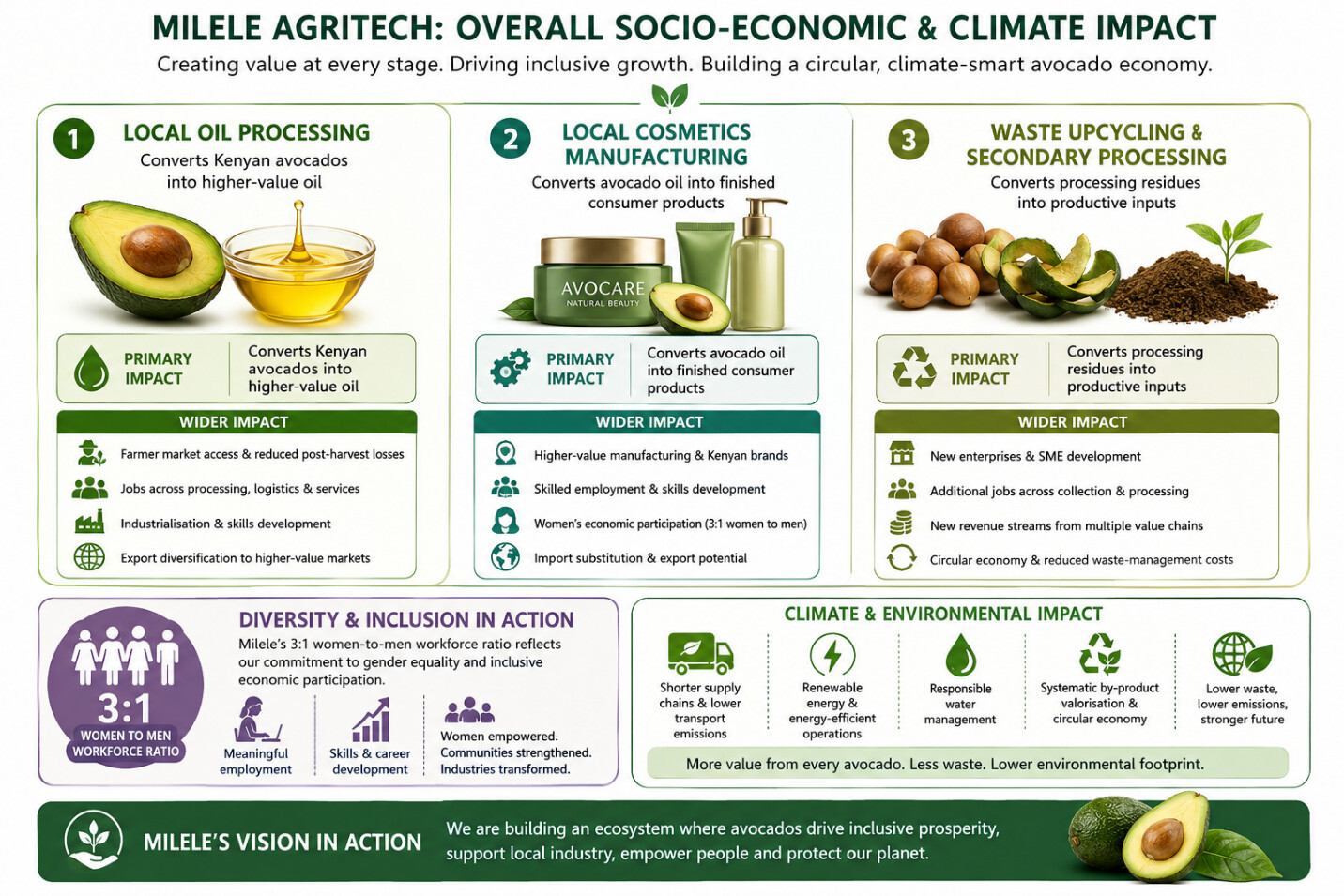

Milele's local avocado oil processing retains more value within Kenya by transforming locally sourced avocados into crude and cold-pressed avocado oil. It creates additional markets for farmers, reduces post-harvest losses, generates direct and indirect employment, strengthens local agro-processing capabilities, and supports export diversification.
From a climate perspective, local processing can reduce transport-related emissions and waste, particularly when fruit is processed closer to farms. The impact is further enhanced through energy-efficient operations, renewable energy, responsible water use and sustainable waste management.

Through Avocare, Milele transforms avocado oil into locally manufactured, higher-value cosmetics, creating a value chain from avocado to oil to finished consumer products. This supports local manufacturing, Kenyan brand development, skilled employment, skills transfer, import substitution and export opportunities. Milele's 3:1 women-to-men workforce ratio also demonstrates its commitment to diversity, inclusion and women's economic participation.
From a climate perspective, local production can reduce reliance on imported finished products and associated supply-chain emissions, particularly when locally sourced inputs, efficient production processes, renewable energy and sustainable packaging are used.
Milele's closed-loop model treats avocado peels, seeds, pulp residues and other by-products as valuable resources rather than waste. The company works with external partners to undertake secondary processing, creating new products and economic opportunities. This approach supports new enterprises, employment, SME development, innovation and additional revenue streams, while reducing waste-management requirements and promoting a circular bioeconomy.
From a climate perspective, upcycling can reduce waste-related emissions, lower demand for virgin raw materials and enable bio-based products or energy recovery, particularly when secondary processing is energy-efficient and sustainably managed.
Recycling partners
Skins, stones, pomace and process water leave the site under agreement with specialist recyclers — not with a disposal contractor. Each of these partners turns one of those streams into feed, fertiliser or energy.
 HomeBiogas Kenya
Biodigesters turning organic waste into cooking gas and liquid bio-fertiliser.
Visit site
HomeBiogas Kenya
Biodigesters turning organic waste into cooking gas and liquid bio-fertiliser.
Visit site
 Flexi Biogas
Domestic and large-capacity biogas systems from Biogas International Limited.
Visit site
Flexi Biogas
Domestic and large-capacity biogas systems from Biogas International Limited.
Visit site
 Nutrimzuri Farmcare
Sustainable animal feeds, insect protein and organic fertiliser for smallholders.
Visit site
Nutrimzuri Farmcare
Sustainable animal feeds, insect protein and organic fertiliser for smallholders.
Visit site
 Ecoprotein Hub
Organic waste solutions through black soldier fly farming, feed and frass.
Visit site
Ecoprotein Hub
Organic waste solutions through black soldier fly farming, feed and frass.
Visit site
 InsectiPro
Insect farm producing feed, food and Fertigro soil inputs at scale.
Visit site
InsectiPro
Insect farm producing feed, food and Fertigro soil inputs at scale.
Visit site
 Cityfresh
Waste management partner collecting and processing organic waste.
Visit site
Cityfresh
Waste management partner collecting and processing organic waste.
Visit site